.png)

Why Elite Sport
"Sport has the power to change the world. It has the power to inspire. It has the power to unite people in a way that little else does. It speaks to youth in a language they understand. Sport can create hope where once there was only despair. It is more powerful than governments in breaking down racial barriers. It laughs in the face of all types of discrimination." Nelson Mandela
The elite sports industry holds an incredibly influential place in society. At its best showcasing incredible human skill and capacity, discipline, talent, resilience, excellence and unites people in celebration like no other.
However, due to numerous factors including the rise of social media, elite athletes are subject to an ever increasing amount of stress and pressure as they’re exposed to a higher public status, expectation and scrutiny than ever before.
Its an environment that reinforces a performance based mindset that becomes a strong part of their identity from a young age. Significantly impacting their professional and personal lives, which can have seriously detrimental effects on their holistic well being, mentally, physically, spiritually and socially, particularly in their close relationships and families. Consequently to navigate this new lifestyle more and more elite athletes and organisations are recognising the desperate need for holistic well being support.
“Investment in sport is not just a sports policy, it’s a health policy and education policy, an anti-crime policy and an anti drugs policy.” Tony Blair
The current holistic well being landscape
Holistic wellbeing support for elite athletes is still in its infancy globally. Where support does exist, it is often fragmented, limited in scope, and difficult to access. As a result, many athletes are left without the comprehensive care they need to navigate the unique pressures of elite sport—including identity, fame, family, finances, career transitions, and the practical and logistical demands of living and competing internationally.
Despite being recognised as major risk factors for both mental and physical health, and as fundamental to healthy identity development, loneliness and isolation remain among the most significant yet overlooked challenges facing elite athletes. Because they're difficult to recognise and diagnose medically, they often go unnoticed and unsupported. While loneliness and isolation are widespread issues across modern society, they are frequently intensified within the high-pressure, performance-driven environment of elite sport. Their effects are far-reaching, impacting not only athletic performance and careers but, more importantly, athletes' personal wellbeing, relationships, and lives beyond sport.
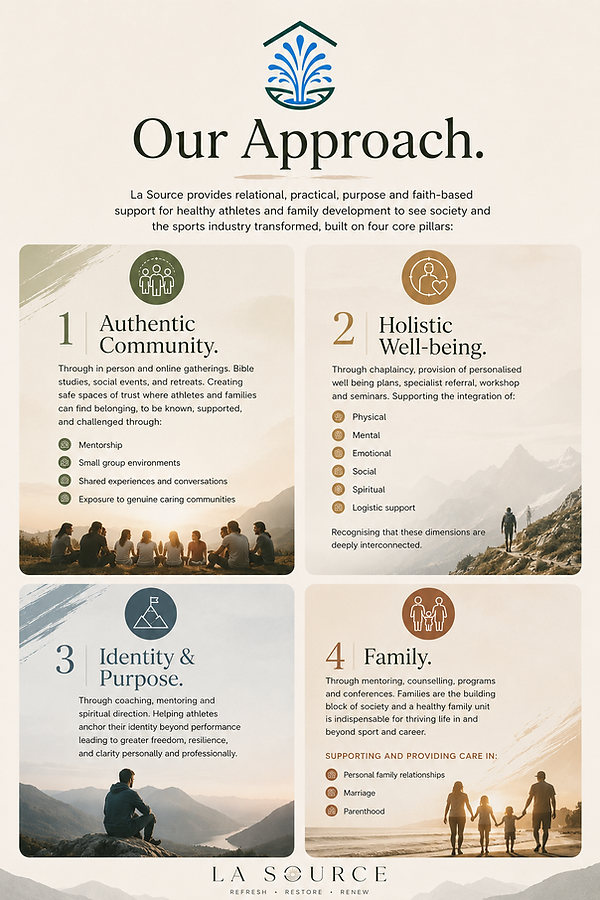
La Source exists to help address these challenges by creating a trusted ecosystem of connection, community, and personalised holistic wellbeing care. Through accessible in-person support whenever possible, complemented by digital services where needed, we aim to provide athletes and their families with the care, resources, and support they need to flourish in sport, life, and beyond.
Who are Elite Athletes?
An elite athlete is a sportsperson who competes at the highest levels of performance within their sport, typically distinguished by exceptional physical ability, technical skill, psychological resilience, and sustained competitive success.
We define elite athletes through a combination of these criteria:
-
Competing professionally or internationally
-
Being selected for national teams or top divisions within a nation
-
Training at a highly specialized and intensive level
-
Competing consistently against top-tier competition
-
Having sport as a central professional or high-performance pursuit
Elite athlete statistics
-
35% of elite athletes and 46.5% of former elite athletes have reported experiencing symptoms of anxiety and depression. (1)
-
57% of female and 27% of male athletes worry about body image issues.(1)
-
34% of professional athletes reported experiencing symptoms of anger management issues.(1)
-
85% of male athletes in a recent study shared that stigma related to mental health made them reluctant to access mental health services. (1)
-
28% current professional male rugby players (rugby union, rugby league, and rugby sevens) reported feeling anxious and/or depressed (3)
-
95% of current and retired rugby players stated that symptoms of common mental disorders (CMD) can negatively influence rugby performances (2)
-
46% mentioned that specific support measures for players were not available in professional rugby. (2)
-
26.5% of high-performance American athletes earn less than $15,000 a year, and another 10% earn between $15,000-$25,000. (5)
-
“Only 50% of all responding high-performance athletes reported any compensation related to their sport, and of those only 11.5% received sponsorships,” (5)
-
Domestic abuse incidents increase by 26% when England (Football team) plays, and 38% if they lose. (6)
-
Jones, L et al. (4) Concluded a theocentric, received approach to identity formation (personal identity that is received from God rather than achieved by athletic performance) provided Christian elite athletes with unprecedented existential fulfilment and security.
(1) Gouttebarge V, Hopley P, Kerkhoffs G, Verhagen E, Viljoen W, Wylleman P, et al. A 12-month prospective cohort study of symptoms of common mental disorders among professional rugby players. Eur J Sport Sci. 2018;18(7):1004–1012.
(2) Gouttebarge V, Kerkhoffs G, Lambert M. Prevalence and determinants of symptoms of common mental disorders in retired professional Rugby Union players. Eur J Sport Sci. 2016;16(5):595–602
(3) Jones, L., Parker, A., & Daniels, G. (2020). Sports Chaplaincy, Theology and Social Theory Disrupting Performance-Based Identity in Elite Sporting Contexts. Religions, 11(12), 660.
(4) Jones, L., Parker, A., & Daniels, G. (2020). Sports Chaplaincy, Theology and Social Theory Disrupting Performance-Based Identity in Elite Sporting Contexts. Religions, 11(12), 660.
(5) Passing the Torch Modernizing Olympic, Paralympic, & Grassroots Sports in America. THE FINAL REPORT OF THE COMMISSION ON THE STATE OF U.S. OLYMPICS & PARALYMPICS 2024. Dionne Koller, Han Xia
(6) Kirby et al. Can the FIFA World Cup Football (Soccer) Tournament Be Associated with an Increase in Domestic Abuse? Journal of Research in Crime and Delinquency Volume 51 Issue 3, May 2014
Core Values
"It Starts at Home"
Sport is our passion. Family is our priority. Our desire is not only for the support and care of the athlete themselves but ultimately we know it 'takes a village' to support and strengthen healthy family units. We believe the family unit is the building block of society and indispensable for a thriving life and purpose in and beyond sport and careers, to seeing transformation in communities and society. That's why we prioritise genuine relationships, authentic community and specialised help when needed to see healing, reconciliation and stronger family relationships, marriage and parenthood.
Belonging
Hope
Freedom
Growth
Resilience
Purpose
Fun
Our values our founded in Biblical Christian principles and guide everything we do, creating a community where people can thrive with confidence, purpose, and joy.
It all starts with BELONGING, feeling seen, valued, and connected.
From that foundation we share and inspire vision for a positive future and a HOPE for everyone.
This inspires a FREEDOM to embrace who we are and have been created to be.
Every circumstance is an opportunity for GROWTH, to discover new strengths and possibilities.
Discovering our PURPOSE, and our identity as gifts that we have received rather than being achieved through accomplishments, and how they help us become influential leaders in our families and communities to make a meaningful difference.
We build RESILIENCE and courage through enduring and overcoming the trials and challenges of sport and life and keep moving forward.
Remembering that FUN, celebration, and enjoying the journey together, with team mates, opponents, fans, family, friends and loved ones is an important part of our Holistic well-being and gift to those around us.